

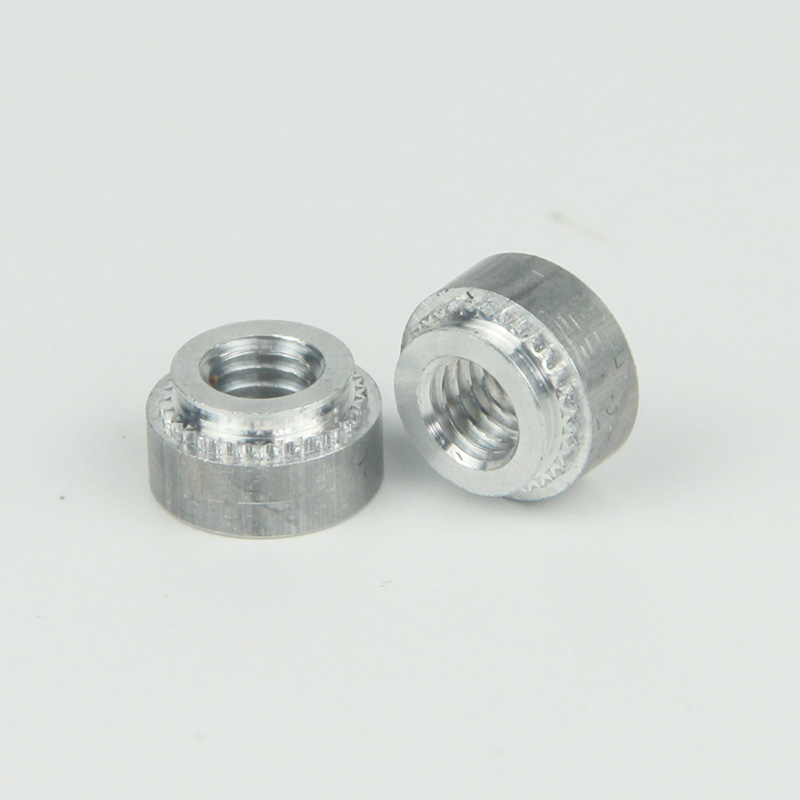
Rivet nut is a compact and convenient screw sleeve. The riveting nut is widely used in the plate connection of various industries such as shipbuilding, vehicles, aviation, electrical appliances, appearance, metal cabinets, elevators, etc. It is easy to operate, reliable and beautiful in connection, low consumption and high efficiency. The deformation of the clinch nut is similar to the expansion deformation process of the simple part or the bureaucratic part, and the expansion deformation degree is generally expressed by the expansion coefficient. Next, we will introduce several methods for the surface treatment of the clinch nut!
1、 Plating and plating
The electroplated part is immersed in an aqueous solution containing the deposited metal compound, and an electric current flows through the plating solution to precipitate and deposit the electroplated metal on the part. Press riveting nut post is also known as press riveting stud or nut post, which is a kind of applied to sheet metal, sheet metal, crate and cabinet. One end of the press riveting nut post is in hexagon shape, the other end is in cylindrical shape, the hexagon side and the middle of the cylinder are provided with a screwdriver slot, the internal shape is internal thread, the hexagon head is pressed into the preset hole of the sheet through the press machine to cause plastic deformation around the hole, and the deformed part is squeezed into the screwdriver slot of the press riveting nut post, so that the press riveting nut post is riveted on the sheet, thus forming an effective fixed internal thread on the sheet.
2、 Mechanical Plating
The product surface is impacted by particles of coated metal and the coating is cold welded to the product surface. There is no unified national standard for riveting screws, only industrial standard. Commonly used in electronic, communication, electrical appliances, chassis, cabinet, metal plate and other industries.
3、 Hot Dip Galvanized
This is done by immersing carbon steel parts in a bath of molten zinc at a temperature of about 510 ° C. Press riveting screws can be divided into fast cutting steel press riveting screws, stainless steel press riveting screws and copper and aluminum press riveting screws, which shall be used in different environments. Generally, specifications from M2 to M6 are mostly used. There is no unified national standard for riveting screws, only industrial standard. Commonly used in electronic, communication, electrical appliances, chassis, cabinet, metal plate and other industries. As a result, the Fe-Zn alloy on the surface of the steel gradually becomes passive zinc on the outer surface of the product.