

The clinch nut is the next generation of rivet fasteners on the market. It changes the traditional way of mounting parts on plates and is a new breakthrough in the plate connection process. Currently, in the sheet metal industry, riveted rivet nuts are widely used to secure threaded nuts to sheet metal parts.
There are two riveting methods and tools. One is riveting with riveting gun, mainly used for riveting sheet metal parts with less varieties and maintenance; The other is sheet metal punching die riveting, mainly used for riveting a large number of single varieties of sheet metal parts. Both riveting methods have fatal disadvantages such as low production efficiency, high labor intensity and poor riveting quality stability. Another riveting method is automatic riveting. The riveting method is simple in operation and can compensate for the above two methods.
1. Rivet gun riveting method
Riveting steps of riveter: remove parts → insert nut → screw rivet head into nut → pull rivet → screw rivet head out of nut → finished product
Disadvantages of riveting method of riveting gun: complicated steps, low efficiency of manual insertion and placement of nuts, low production efficiency, high skill requirements for employees, short service life of riveting gun and short service life of riveting gun head.
2. Die riveting method
Die riveting steps: take part → insert nut → position on die → press riveting → finished product, defects of die riveting method: complicated steps, low manual nut insertion efficiency, low production efficiency, poor compatibility between fixed stroke riveting method and nut length deviation, unstable riveting quality.
3. Automatic riveting scheme design
Automatic plug-in equipment has been widely used in the metal plate industry, and the technology has been fairly mature. However, since the rivet nut used by the automatic insertion device is a clinch nut, there is no precedent for the use of a rivet nut. Compared with pull riveting, press riveting still has the following disadvantages:
(1) For rivet nuts of the same specification, the cost of the compression nut is higher than that of the rivet nut (according to the market price).
(2) Pressure riveting has strict requirements on plate thickness (material thickness ≥ 1.0mm), so it is not applicable to parts requiring thin material (material thickness<1.0nm). If the thickness of the plate is increased to accommodate the riveting, the production cost will be greatly increased. Meanwhile, the structural parameters of rivet nuts for different plate thicknesses are different. If rivet nuts are used in production, the variety and size of nuts will increase, resulting in increased production and quality management costs.
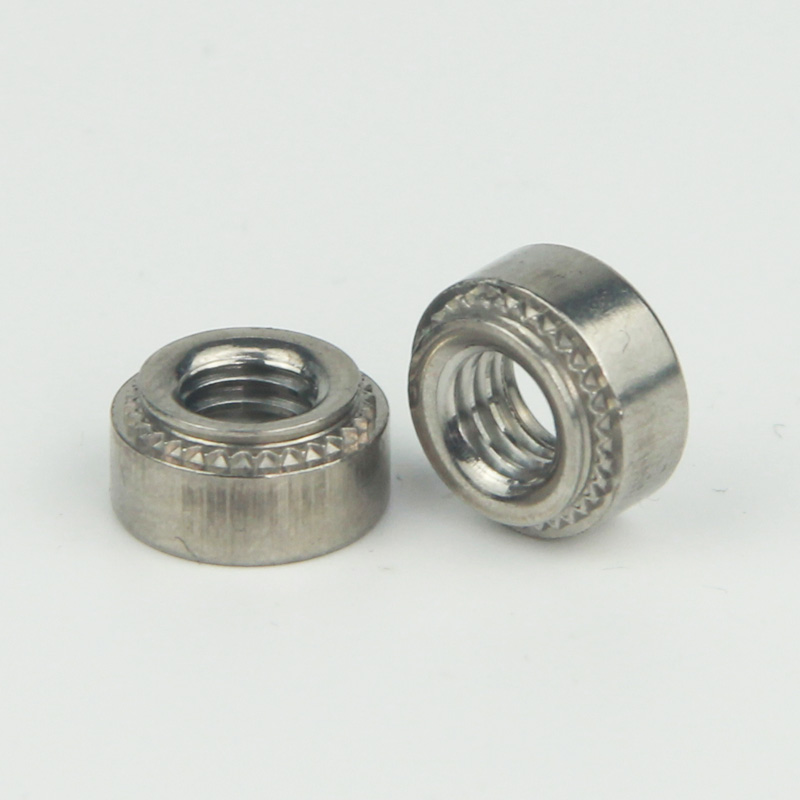
Most rivet nuts used in the sheet metal industry are hexagon nuts. At present, universal automatic insertion equipment cannot be used for hexagon rivet nuts, mainly because automatic insertion cannot realize the directional drive of hexagon rivet nuts. The issue of directional delivery of riveted nuts can be solved by replacing hexagonal riveted nuts with cylindrical riveted nuts. However, there is a risk of rotating quality when screwing in the screw after the cylindrical rivet nut has been riveted.
At present, the design principle of riveted connection structure adopted by the metal plate industry is that the riveted hole and riveted nut have the same shape. For example, a square rivet nut hole matches the square rivet nut and a round rivet nut hole matches the round rivet nut. If this principle is applied to a round rivet nut hole with a round rivet nut, there will be serious rivet quality problems. When the screw is screwed into the clinch nut, the nut rotates and the part cannot be assembled and secured. The main reason for rotation of the rivet nut is that the circular rivet nut cannot form a structure preventing rotation after being riveted.