

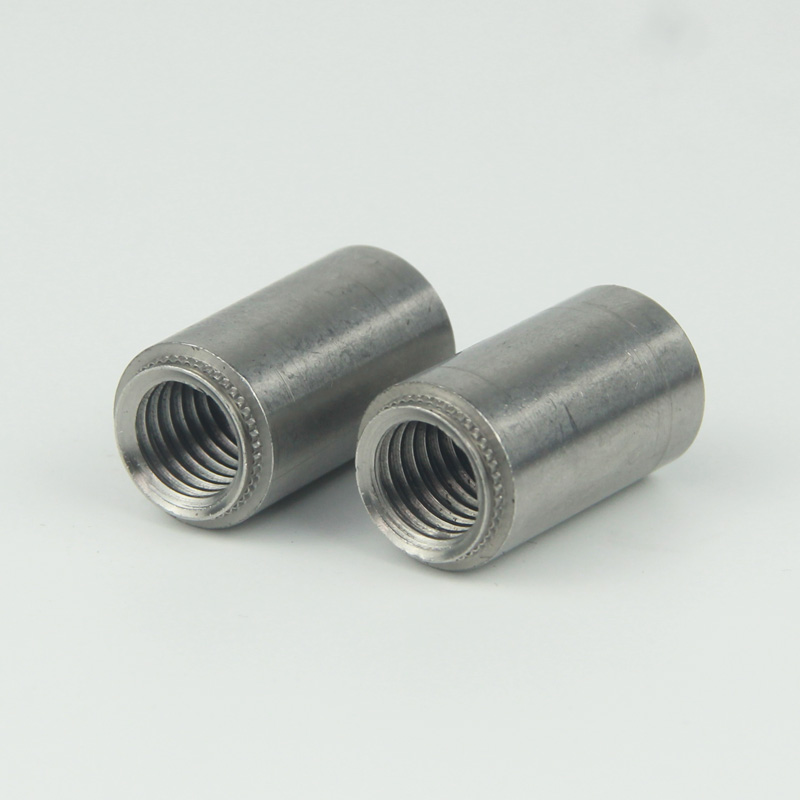
As a fixed connection technology, welded nuts play an important role in metal manufacturing and structural engineering. They provide a reliable solution for building high-strength, durable and stable connections by directly welding nuts to the surface of metal components.
1. Working principle
Welding nuts are fixed to metal plates or other metal components using methods such as arc welding, gas shielded welding, or laser welding. During the welding process, the metal on the surface of the nut and substrate melts and combines, forming a metallurgical bond after cooling, ensuring extremely high connection strength and durability.
2. Advantages
(1) High strength connection
The connection points formed by welding can withstand great tensile and torsional forces, making them suitable for high load applications.
(2) Anti loosening measures
Welding nuts are almost impossible to loosen due to vibration or external forces.
(3) Wide applicability
Can be used for metal parts of various thicknesses and materials, including but not limited to steel, stainless steel, and aluminum.
(4) Simplify assembly
Pre fixing welding nuts reduces on-site assembly steps and accelerates production speed.
3. Application Fields
(1) Building Structure
Reinforcement connections in bridges and steel structures.
(2) Automobile manufacturing
Fixing of vehicle body frame and chassis components.
(3) Heavy Machinery
Assembly of heavy equipment such as cranes and excavators.
(4) Railway transportation
Connection of structural components of rail vehicles.
(5) Electrical equipment
Tightening of internal structures of distribution cabinets and control boxes.
4. Selection and Welding Techniques
(1) Nut selection
Select appropriate materials and specifications for welding nuts based on the application environment, such as stainless steel nuts suitable for corrosive environments.
(2) Preprocessing
Clean the nut and substrate surface before welding, remove oil stains and rust, and ensure welding quality.
(3) Welding technology
Choose appropriate welding methods and parameters to avoid thread damage or deformation caused by overheating.
(4) Cooling treatment
After welding, cool appropriately to avoid cracks caused by thermal stress.
(5) Quality inspection
After welding is completed, check the integrity of the weld seam and the availability of the threads, and perform non-destructive testing if necessary.
Welding nuts have become an indispensable fastening method in many industrial fields due to their strong performance and reliability in metal component connections. The correct selection and welding process are key to ensuring its performance.