

Different materials of rivet nuts have significant differences in performance, and understanding these differences can help select the appropriate rivet nut according to specific application needs. The following are performance comparisons and selection suggestions for common materials such as rivet nuts:
1. Performance comparison of rivet nuts made of different materials
Steel (carbon steel and alloy steel)
(1) Carbon steel
Performance: High strength, low cost, but poor corrosion resistance.
Application: Commonly used in general mechanical assembly and fixing situations.
Attention: Rust prevention treatment is required to extend the service life.
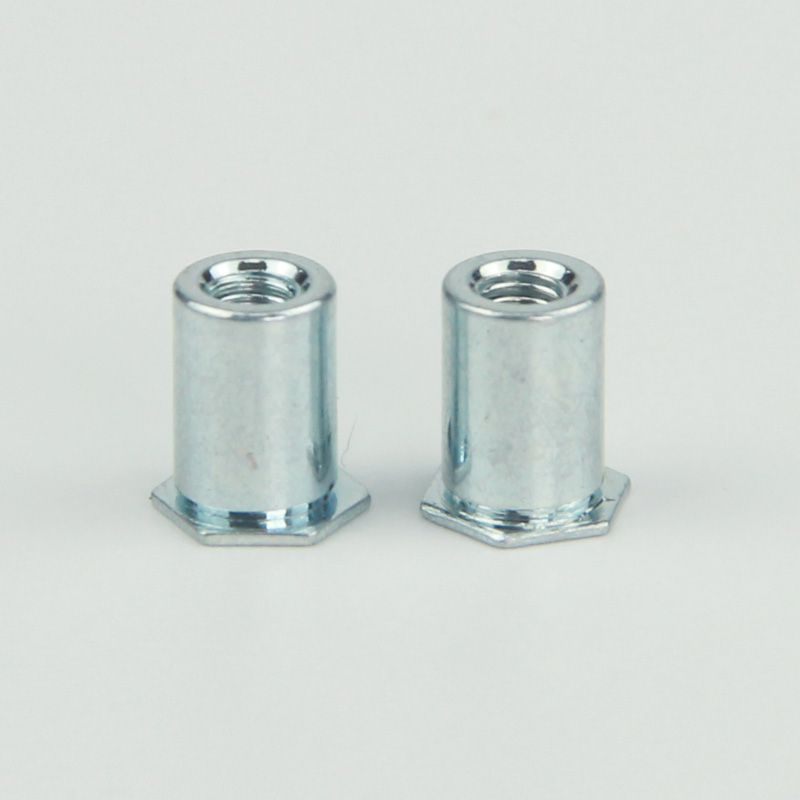
(2) Alloy steel (such as 10B21, 20CrMo):
Performance: Higher strength, good wear resistance, and some alloys also have good high temperature resistance.
Application: Used in situations where high loads and stresses are applied, such as automobiles and heavy machinery.
Attention: The price is relatively high and usually requires heat treatment to increase performance.
(3) Stainless steel
Type: 304, 316, etc
Performance: It has excellent corrosion resistance and high temperature resistance, with moderate strength.
Application: Suitable for humid and highly corrosive environments, such as chemical, food processing, and marine applications.
Attention: Although the cost is high, its excellent corrosion resistance can reduce maintenance requirements and replacement frequency.
(4) Aluminum alloy
Performance: Lightweight, corrosion-resistant, good thermal conductivity, but low strength and hardness.
Application: Used for applications with high lightweight requirements, such as aerospace products.
Attention: Due to its low strength, it is usually used in situations where the load-bearing requirements are small.
(5) Brass
Performance: Good corrosion resistance and conductivity, moderate strength, easy to process.
Application: Commonly used in electrical connectors and situations requiring good conductivity.
Attention: Relatively expensive, suitable for applications that require high conductivity or corrosion resistance.
2. Choose Suggestions
When selecting the appropriate material for rivet nuts, comprehensive consideration should be given to the specific application environment, performance requirements, and cost budget
(1) Consider environmental factors
Corrosive environment: If the application environment is humid or highly corrosive, stainless steel or aluminum alloy materials should be selected.
High temperature environment: Alloy steel or high-temperature corrosion-resistant stainless steel may be more suitable in high temperature environments.
(2) Evaluate mechanical load
High load: For applications that require high loads, such as heavy machinery and automobiles, it is recommended to choose alloy steel or high-strength steel.
Light load: For applications with lower loads, aluminum alloy or brass materials can be considered.
(3) Economic considerations
Cost budget: If the budget is limited, carbon steel rivet nuts may be a more economical choice, but their corrosion resistance needs to be considered to meet the requirements.
Long term use: If long-term use or use in harsh environments is required, it may be necessary to invest in more expensive materials such as stainless steel to reduce maintenance and replacement costs.
(4) Processing and installation
Processing difficulty: Some materials (such as aluminum alloy) are easier to process, while others (such as stainless steel) are more difficult to process. When selecting materials, it is necessary to consider the processing equipment and technical capabilities.
Installation tool: Ensure that the selected material's rivet nut is compatible with existing riveting tools to avoid difficulties during installation.
3. Summary
Different materials of rivet nuts have their own characteristics in terms of performance, and when selecting, factors such as application environment, load requirements, cost budget, and processing difficulty should be comprehensively considered. By understanding the advantages and disadvantages of various materials, material selection suitable for specific applications can be made to ensure the long-term stability and reliability of rivet nuts.