

In addition to the core process, there are also significant differences between electroplating and hot-dip galvanizing of rivet nuts in terms of processing equipment and process points, which directly affect the zinc layer thickness, bonding strength, and performance of rivet nuts
1. Details of hot-dip galvanizing process
The hot-dip galvanizing process involves more steps and requires strict pre-treatment of the rivet nut. It needs to go through multiple pre-treatment processes such as oil removal, acid washing, immersion, and drying before immersing the rivet nut into the molten zinc pool. The immersion time of zinc should be precisely controlled according to the size and thickness of the rivet nut to ensure uniform thickness of the zinc layer (usually the zinc layer is thicker, up to 85 μ m or more). For example, in the hot-dip galvanizing process of large-sized rivet nuts used in construction machinery, it is necessary to focus on controlling the galvanizing temperature and time to avoid thread blockage caused by excessive zinc layer, which may affect subsequent assembly.
2. Details of galvanizing process
Electrogalvanizing requires the use of professional electrolytic equipment for processing. After the rivet nut undergoes pre-treatment processes such as oil removal and acid washing, it is immersed in an electrolytic solution containing zinc salts. By connecting the positive and negative poles of the electrolytic equipment and utilizing the directional movement of current, zinc ions precipitate and deposit on the surface of the rivet nut to form a zinc layer. The zinc layer thickness of this process is relatively thin (usually 5-15 μ m), which can accurately control the uniformity of the zinc layer and meet the processing requirements of high-precision rivet nuts (such as micro rivet nuts used in electronic devices). It can effectively preserve the thread accuracy and dimensional tolerance of rivet nuts and avoid the influence of the process on assembly performance.
Differences in appearance and performance
The appearance of rivet nuts after galvanizing and hot-dip galvanizing is significantly different, which can be used as a visual reference for scene selection. The specific appearance features are as follows:
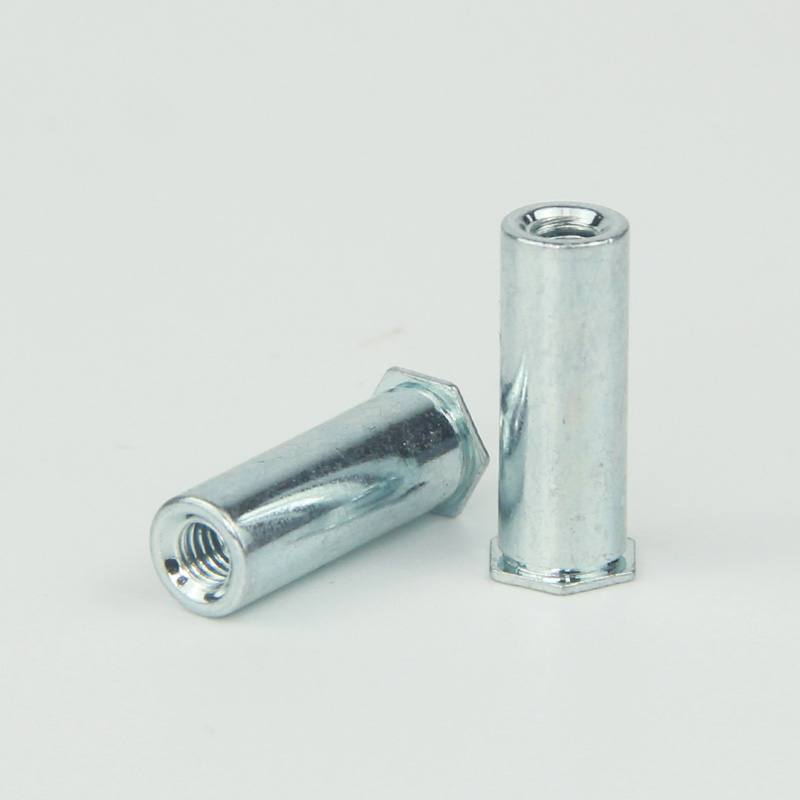
1. Appearance of hot-dip galvanized rivet nut
The overall appearance of hot-dip galvanized rivet nuts is slightly rough, and the surface will inevitably produce features such as process water marks and zinc droplets, especially at one end of the rivet nut (hanging plated end). The overall appearance of the zinc layer is silver white with low glossiness, but the zinc layer is fully covered without defects such as missed plating or exposed substrate, making it suitable for heavy-duty scenarios with low appearance requirements and emphasis on anti-corrosion performance (such as rivet nuts for construction and mining machinery).
2. Appearance of electroplated galvanized rivet nuts
The surface of the electroplated galvanized rivet nut is smooth and flat, without obvious process defects. The core appearance color is yellow green, and it can be presented in various colors such as rainbow, blue white, white with green light according to process requirements. The entire surface of the rivet nut is basically free of zinc nodules, clumps, and other phenomena. The threads are clear and complete, suitable for scenarios with high requirements for appearance accuracy and assembly accuracy (such as rivet nuts for automotive interiors and electronic devices).
Core recommendations for the selection of electroplated and hot-dip galvanized rivet nuts
The core difference between electroplating and hot-dip galvanizing of rivet nuts is essentially the process positioning difference between "light anti-corrosion, high precision" and "heavy anti-corrosion, strong tolerance". The adaptation scenarios of the two are clear, and the selection needs to be comprehensively judged based on the usage environment, assembly requirements, and anti-corrosion requirements of rivet nuts
If rivet nuts are used in heavy-duty, outdoor, humid, or acid alkali corrosion scenarios (such as engineering machinery, construction machinery, mining equipment), hot-dip galvanizing technology is preferred. Its thicker zinc layer can achieve long-term corrosion resistance and withstand complex working conditions impact;
2. If rivet nuts are used for light loads, indoor environments, and high requirements for appearance accuracy and thread accuracy (such as electronic devices, automotive interiors, and precision instruments), electroplating technology is preferred. Its smooth surface and precise size control can ensure assembly reliability and aesthetic appearance.
As a core fastener, the choice of galvanizing process for rivet nuts directly affects the operational stability and service life of the equipment. It is necessary to accurately control the core differences between the two galvanizing processes and make reasonable selections based on practical application scenarios in order to maximize the assembly value and anti-corrosion ability of rivet nuts, and provide core guarantees for the reliable operation of equipment in various industries.