

What materials and scenarios are rivet nuts suitable for?
Rivet nut is a commonly used fastener that is suitable for many materials and scenarios. Next, we will provide a detailed introduction to the materials and scenarios suitable for rivet nuts, and analyze their characteristics and advantages.
Firstly, rivet nuts are suitable for various materials. It can be used for metal materials such as steel, stainless steel, copper, aluminum, etc. These metal materials have high strength and corrosion resistance, and are widely used in fields such as machinery, automobiles, and construction. Rivet nuts are also suitable for some non-metallic materials such as plastic, rubber, etc. These materials can provide reliable connections and fastening effects by riveting fixed nuts.
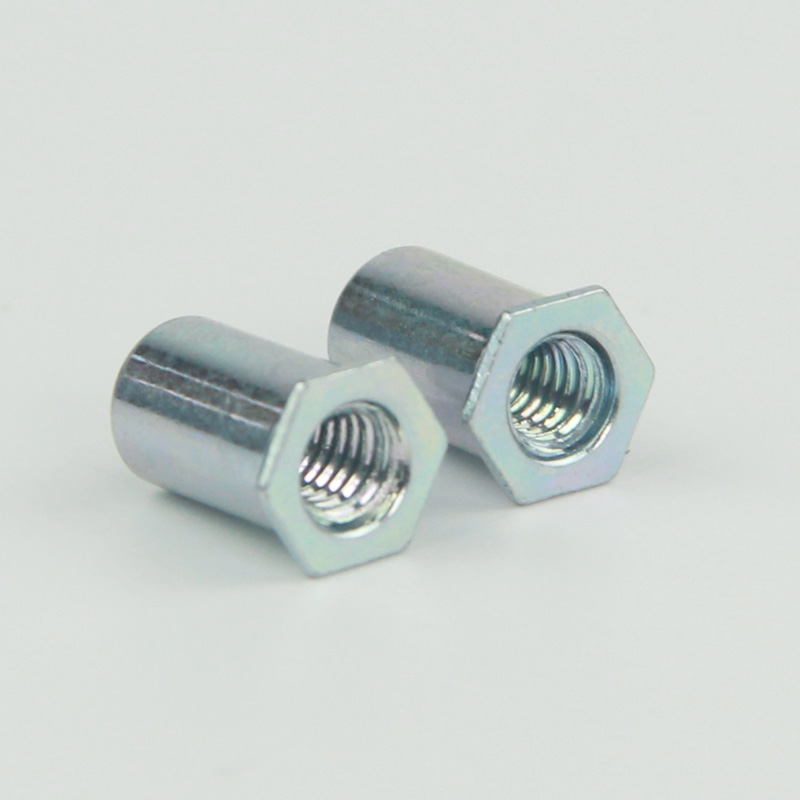
Secondly, rivet nuts are suitable for various scenarios. Firstly, it can be used in scenarios where space is limited or difficult to access. The characteristic of rivet nuts is that they do not require insertion and fixation from the other side, only one side is needed for installation and disassembly. Therefore, in scenarios where equipment or structure is limited, rivet nuts can provide a convenient and fast fixing solution. Secondly, rivet nuts are suitable for scenarios that require frequent disassembly and reinstallation. Traditional threaded connections require the use of bolts and nuts, which require rotating the threads for fixation and can easily cause damage or wear. The rivet nut can be fixed by pressure without rotation, and can be reused multiple times, improving the efficiency and reliability of fixation. In addition, rivet nuts are suitable for scenarios with material limitations. Some thin-walled or brittle materials, such as glass, ceramics, etc., are not suitable for thread cutting, but can be fixed using rivet nuts. Rivet nuts can form a uniform fixing surface through pressure, dispersing force and reducing damage to materials.
Rivet nuts have many advantages. Firstly, it can provide a high-strength fixing effect. The design of the rivet nut enables it to withstand high pressure and tension, ensuring the safety and reliability of the connection. Secondly, it can provide good sealing performance. By using appropriate sealing gaskets, rivet nuts can provide a good sealing effect, preventing liquid or gas leakage. In addition, rivet nuts also have the characteristic of anti loosening. Under normal use and vibration conditions, rivet nuts can be prevented from loosening and falling off through the design of an internal clamping mechanism. Rivet nuts have a certain lifespan and reusability. Rivet nuts are usually made of high-strength stainless steel material, which has a long service life and can be disassembled and reinstalled multiple times to reduce material waste.
In summary, rivet nuts are suitable for various materials and scenarios, and have many advantages. It can provide high-strength fixing effect, suitable for scenarios with limited space or difficult to access, can be disassembled and reused multiple times, and is suitable for various metal and non-metal materials. In practical applications, we can choose suitable rivet nuts according to specific needs to provide reliable and convenient fixing solutions.